
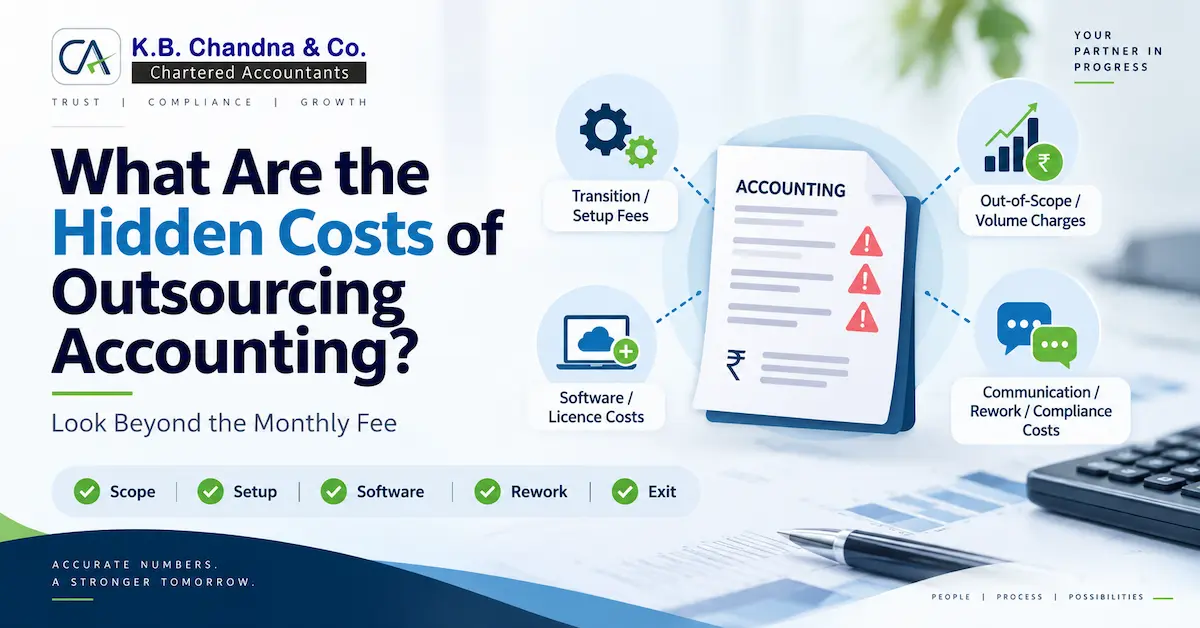
What Are the Hidden Costs of Outsourcing Accounting?
Outsourcing accounting can help businesses reduce administrative workload, access professional expertise, and avoid the expense of maintaining a large in-house accounting team. However, while the advertised outsourcing fee may appear straightforward, businesses should also consider the hidden costs of outsourcing accounting before choosing a service provider.
These costs do not necessarily mean that outsourcing is expensive. Instead, they highlight areas that businesses should evaluate carefully when comparing different accounting outsourcing companies in India.
Understanding these potential costs can help businesses choose an outsourcing model that provides value while avoiding unexpected expenses.
What Is Accounting Outsourcing?
Accounting outsourcing involves hiring an external accounting firm or service provider to manage some or all of a company’s financial functions.
Depending on the agreement, outsourced accounting services may include:
- Bookkeeping
- Bank reconciliation
- Accounts payable and receivable
- Financial reporting
- Payroll accounting
- GST accounting support
- Tax-related accounting
- Monthly closing
- Management reports
Businesses can outsource specific accounting tasks or their complete accounting function.
While outsourcing can provide flexibility, the total cost depends on the scope of services, complexity of the business, transaction volume, technology requirements, and level of support required.
1. Additional Service Charges
One of the most common hidden costs is additional charges for services that are not included in the basic package.
For example, a provider may offer bookkeeping at a fixed monthly fee but charge separately for:
- Additional financial reports
- GST-related support
- Payroll processing
- Year-end closing
- Tax support
- Historical bookkeeping
- Additional reconciliations
- Urgent accounting requests
Before signing an agreement, businesses should ask for a detailed breakdown of what is included and what is billed separately.
2. Costs of Transitioning to a New Provider
Moving accounting activities from an internal team or an existing accounting provider to a new outsourcing company requires time and resources.
The transition may involve:
- Transferring accounting records
- Reviewing historical transactions
- Setting up accounting software
- Creating new workflows
- Training the outsourcing team
- Reconciling opening balances
- Reviewing previous financial records
Some providers include transition services in their fees, while others may charge separately.
Businesses should clarify transition costs before starting the outsourcing relationship.
3. Accounting Software and Technology Costs
Accounting outsourcing may require businesses to use specific accounting software, cloud platforms, reporting tools, or document management systems.
Depending on the service arrangement, the business may need to pay for:
- Accounting software subscriptions
- Additional user licenses
- Cloud storage
- Payroll software
- Reporting tools
- Integration services
These costs can increase the overall expense if they were not included in the original outsourcing proposal.
4. Data Migration Costs
If a company is moving from one accounting system to another, historical financial data may need to be migrated.
Data migration can involve:
- Exporting old records
- Cleaning financial data
- Formatting information
- Importing transactions
- Verifying balances
- Reconciliations
Businesses with several years of financial records may require additional time and professional support during the migration process.
5. Internal Management Time
Outsourcing does not mean that the business has no responsibilities.
Internal employees may still need to:
- Provide invoices
- Submit expense documents
- Approve payments
- Answer accounting queries
- Review reports
- Provide bank statements
- Approve reconciliations
- Communicate with the accounting team
The time spent coordinating with the outsourcing provider is an indirect cost that businesses should consider.
6. Costs Caused by Poor Communication
Communication problems can create unexpected costs.
If instructions are unclear or financial information is provided late, the accounting team may need additional time to clarify transactions and correct records.
For businesses working with an offshore or geographically distant provider, differences in working hours can also affect communication.
A clear communication process and defined responsibilities can help reduce these problems.
7. Additional Charges for Complex Transactions
Not every accounting transaction requires the same amount of work.
Businesses involved in multiple locations, currencies, entities, revenue streams, or complex transactions may require additional accounting support.
For example, an organization with:
- Multiple business entities
- International transactions
- Foreign currency transactions
- High transaction volumes
- Complex revenue structures
may require more accounting resources than a small business with straightforward transactions.
Therefore, businesses should ensure that the outsourcing quotation reflects the actual complexity of their accounting requirements.
8. Quality Control and Review Costs
Outsourcing accounting does not eliminate the need for management oversight.
Businesses should regularly review:
- Financial statements
- Bank reconciliations
- Outstanding receivables
- Payables
- GST records
- Expense classifications
- Monthly reports
If the outsourced provider does not have strong quality-control procedures, the business may need to spend additional internal resources reviewing and correcting accounting work.
Choosing an experienced provider can help reduce this risk.
9. Data Security and Compliance Costs
Accounting records contain sensitive financial and business information.
Businesses should evaluate how their accounting provider protects:
- Financial statements
- Bank information
- Customer data
- Vendor information
- Employee records
- Tax information
Depending on the business and industry, additional security measures may be required.
These can include secure file-sharing systems, access controls, encryption, backup systems, and confidentiality procedures.
Although these measures can add to costs, they are important considerations when outsourcing financial functions.
10. Costs of Changing Providers
Businesses should also consider the potential cost of moving to another accounting provider in the future.
If financial records are poorly organized or the outsourcing agreement does not clearly address data ownership and transition procedures, changing providers can become difficult.
Before entering an outsourcing agreement, businesses should understand:
- Who owns the accounting data
- How records will be returned
- What happens when the contract ends
- Whether data can be exported
- Whether transition assistance is available
A clear exit process can prevent unnecessary costs later.
11. Unexpected Compliance Support Costs
Basic bookkeeping and compliance support are not always the same thing.
A business may initially outsource bookkeeping but later require additional assistance with:
- GST compliance
- Income tax
- Audit preparation
- Financial statements
- Statutory audit coordination
- Tax notices
- Regulatory reporting
These additional requirements can increase the total cost of outsourcing.
Businesses should therefore discuss their expected compliance requirements with the accounting provider before finalizing the scope of work.
How to Avoid Hidden Costs When Outsourcing Accounting
Businesses can reduce unexpected expenses by taking a few important steps.
Ask for a Detailed Pricing Structure
Instead of looking only at the monthly fee, ask the provider to explain:
- What services are included
- What services are excluded
- Additional hourly or service charges
- Setup fees
- Technology costs
- Transition charges
- Year-end accounting costs
Define the Scope of Work
A clear scope of work should specify exactly what the outsourcing provider is responsible for.
For example, if bookkeeping is included but GST filing is not, this should be clearly documented.
Check Transaction Limits
Some providers may price services based on the number of monthly transactions.
Ask whether additional charges apply when transaction volumes exceed the agreed limit.
Establish Communication Procedures
Define:
- Primary contact persons
- Reporting frequency
- Document submission process
- Response times
- Escalation procedures
This can help prevent delays and unnecessary communication costs.
Review the Service Agreement
The agreement should clearly mention pricing, responsibilities, data ownership, confidentiality, service levels, and termination procedures.
Businesses should understand the complete commercial arrangement rather than focusing only on the advertised monthly price.
Is Accounting Outsourcing Still Cost-Effective?
Despite these potential hidden costs, accounting outsourcing can remain a practical option for many businesses.
The overall value should be evaluated against the total cost of maintaining an in-house accounting function.
An internal accounting department may involve:
- Salaries
- Recruitment
- Employee benefits
- Training
- Accounting software
- Office infrastructure
- Management time
- Employee turnover
Outsourcing may provide access to professional accounting expertise without requiring the business to build a complete internal department.
The key is to compare the total cost and scope of services, rather than comparing only the headline outsourcing fee.
Choosing the Right Accounting Outsourcing Company in India
Businesses looking for accounting outsourcing companies in India should evaluate more than pricing.
Consider the provider’s:
- Accounting experience
- Professional qualifications
- Service scope
- Technology infrastructure
- Data security practices
- Communication process
- Reporting standards
- Scalability
- Client support
- Contract terms
An experienced accounting firm can provide services ranging from bookkeeping and financial reporting to accounting compliance and tax support.
For businesses with operations in Delhi and other parts of India, choosing a professional accounting firm in India with suitable expertise can make the outsourcing process more structured and transparent.
Conclusion
The hidden costs of outsourcing accounting usually arise from additional services, transition work, software, data migration, complex transactions, communication, compliance support, and management oversight.
These costs do not mean businesses should avoid outsourcing. Instead, they highlight the importance of understanding the complete pricing structure before selecting a provider.
By defining the scope of work, asking about additional charges, reviewing the service agreement, and choosing an experienced provider, businesses can make more informed decisions about outsourced accounting.
For companies considering accounting outsourcing services in India, the right provider should offer clear pricing, professional expertise, reliable processes, and transparent communication.